
Chapter · 02
Quick-commerce pressure, the retail landscape, and the big crack.
Landscape · Forces · Gap
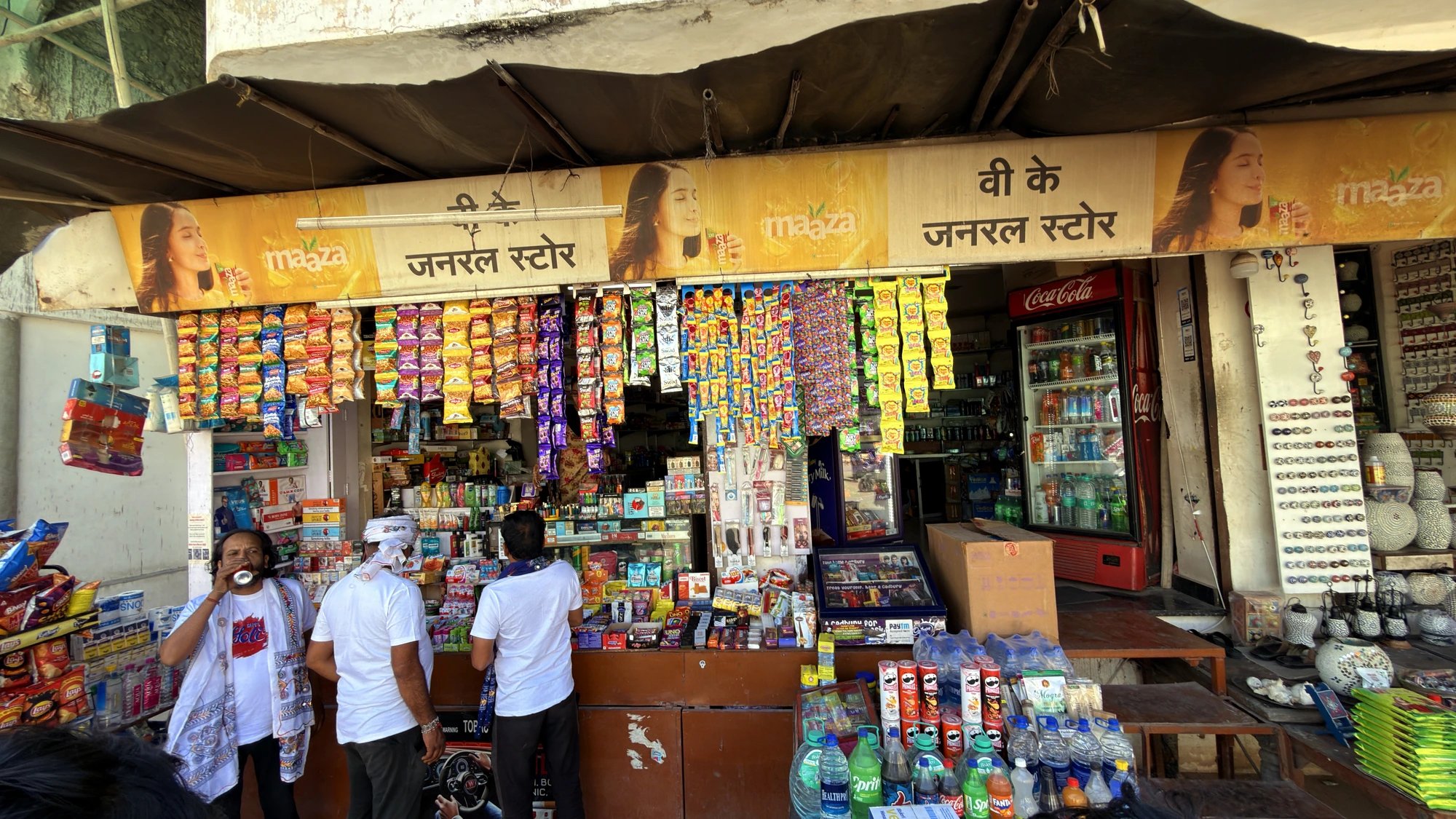
B.K. General Store — the format under pressure, still standing.
Order anything in a few clicks, pay a small convenience charge, and what feels like magic shows up at your doorstep. And in that same moment, the person you wave at while receiving that order — that is the call of death for the store owner you once depended on.
It sounds harsh, but that is the reality. This is not just a business number — it is a direct hit on livelihoods. That is not a small shift; that is a structural collapse in motion. The threat is real, and it is already here.
0
kirana stores shut in the last two years
0 lakh+
lives touched, counting families
- 01No customer-facing store — only apps as the interface
- 02Dark stores placed near residential clusters for speed
- 03Limited, high-frequency selection — not endless variety
- 04Real-time demand tracking and continuous optimization
- 05Picking and packing designed for efficiency, not experience
- 06Delivery built for minutes, not hours
- 07Decisions driven by data, not memory or relationships
A backend-first, data-driven fulfilment model competing on speed, convenience and reliability — the same promise local stores were built on, executed with almost zero friction.
While urban affluent India lives on apps, the mass market — the hundreds of millions who actually drive India's consumption — remains anchored in the khata and the corner shop.
233M
The Mass Market
They buy small and often. With an AOV of ₹150, digital logistics costs of 18–22% make apps unviable. The kirana wins on micro-liquidity.
households
42M
The Affluent
Time is the scarcest commodity. They pay a premium for convenience, driving the quick-commerce surge.
households
69M
The Hybrid Segment
Hypermarkets for the monthly stock-up; kiranas for the "missing ingredient" moments.
households
The apps are fighting over who can burn more capital to deliver a pack of biscuits.
The kirana wins because, apart from a zero-cost marketing budget, it is a community hub. The store owner knows your name, your brand of tea, even which regional masala you prefer. While platforms scale to 10,000+ SKUs, they lack the hyperlocal intelligence of an owner who curates 500–1,500 SKUs for the 200 families on his street.
Discounts create short-term growth. Trust, relationships and consistency are roots — they hold customers in place when conditions change. Without roots, even healthy-looking growth does not last.
Offline retail has not been replaced — it has become part of a hybrid behaviour. On a five-point scale, offline buyers scored 4 on staying loyal to a fixed shop. Retailers who compete only on price burn margins; retailers who build loyalty buy resilience.
Most offline stores are not just shops — they are the centre of life for entire families. They do not switch off. Every decision, every problem, every small win flows through the household. The business and life are completely intertwined.
ROLE 01
Primary Owner & Decision Holder
Holds complete control over money, credit, suppliers and structural decisions. The store runs from this person’s memory. Their absence creates immediate decision paralysis.
Founder · senior family member
ROLE 02
Supply & Operations Handler
The physical backbone — unloading, stacking, shelf order, supplier timing. Executes decisions; first to feel the impact of poor ones.
Elder son · trusted helper
ROLE 03
Digital & Phone-Based Handler
Manages UPI, QR codes, WhatsApp orders. Introduces new tools — but adoption depends on the owner’s approval, so digital gets layered on top of manual.
Son or daughter, 18–30s
ROLE 04
Storefront Presence & Continuity
Keeps the store open, secure and functional through the day. No decision authority — its function is stability and presence.
Wife or mother · elder member
The moment even one role drops out, the entire responsibility collapses back onto the primary decision holder. The work remains constant — only the load concentrates on one person, because they carry the highest risk and accountability.
On one side
Structured, data-driven organisations
- Clear SOPs for every function
- Continuous data capture and feedback loops
- Technology embedded at every layer
- Increasing use of AI for optimization
On the other
Small retail that is not truly a system
- Informal, inconsistent processes
- Gut-driven, reactive decision-making
- Data fragmented across memory, notebooks, people
- Control centralised — often a bottleneck
The real challenge is not building systems. It is enabling these businesses to become systems — without forcing them to stop being what they already are.
The constraint is not affordability. It is perceived value versus perceived risk, shaped by behaviour: any new system must deliver clear, immediate value, feel frugal, work almost invisibly — and never take away control.
Next Chapter
Random AI music — not the best, but keeps you going