
Chapter · 04
From 134 raw notes to a sharp, buildable design brief.
Patterns · Insights · Defining

Every packet a data point — none of it recorded.
What a user says is only one layer. Their actions, intent, tone and hesitation often reveal more than their words. So every note was classified with a colour-coded system — defining the nature, context and intent behind each entry. Pick a colour:
Interesting Observations
Directional nudges pointing toward deeper insights or strategic directions that are not immediately visible.
52 notes of this kind
An insight is not an observation — it has to be actionable. Notes were clustered by similarity; clusters were reframed until multiple signals pointed at the same underlying truth.
The Eight Themes
Not direct solutions — focused directions that emerge from repeated patterns, where intervention can create real impact without forcing unnatural change.
Structuring invisible systems — without breaking them
Kirana stores already run on informal systems built on memory and relationships. The opportunity is to structure these without disrupting their natural flow.
Reducing cognitive load while retaining control
The owner carries the entire system mentally. Offload repetitive decisions and support thinking without taking away authority.
Enabling passive data capture for better decisions
Decisions lack data not because it is unavailable, but because capturing it requires effort. Record and structure data without demanding active input.
Bridging front-end speed with back-end visibility
Sales happen fast but management lags behind. Connect these layers so speed is maintained while visibility improves.
Enabling trust-based delegation without increasing risk
Delegation is limited by trust and fear of loss. Share responsibility while keeping risk and control in balance.
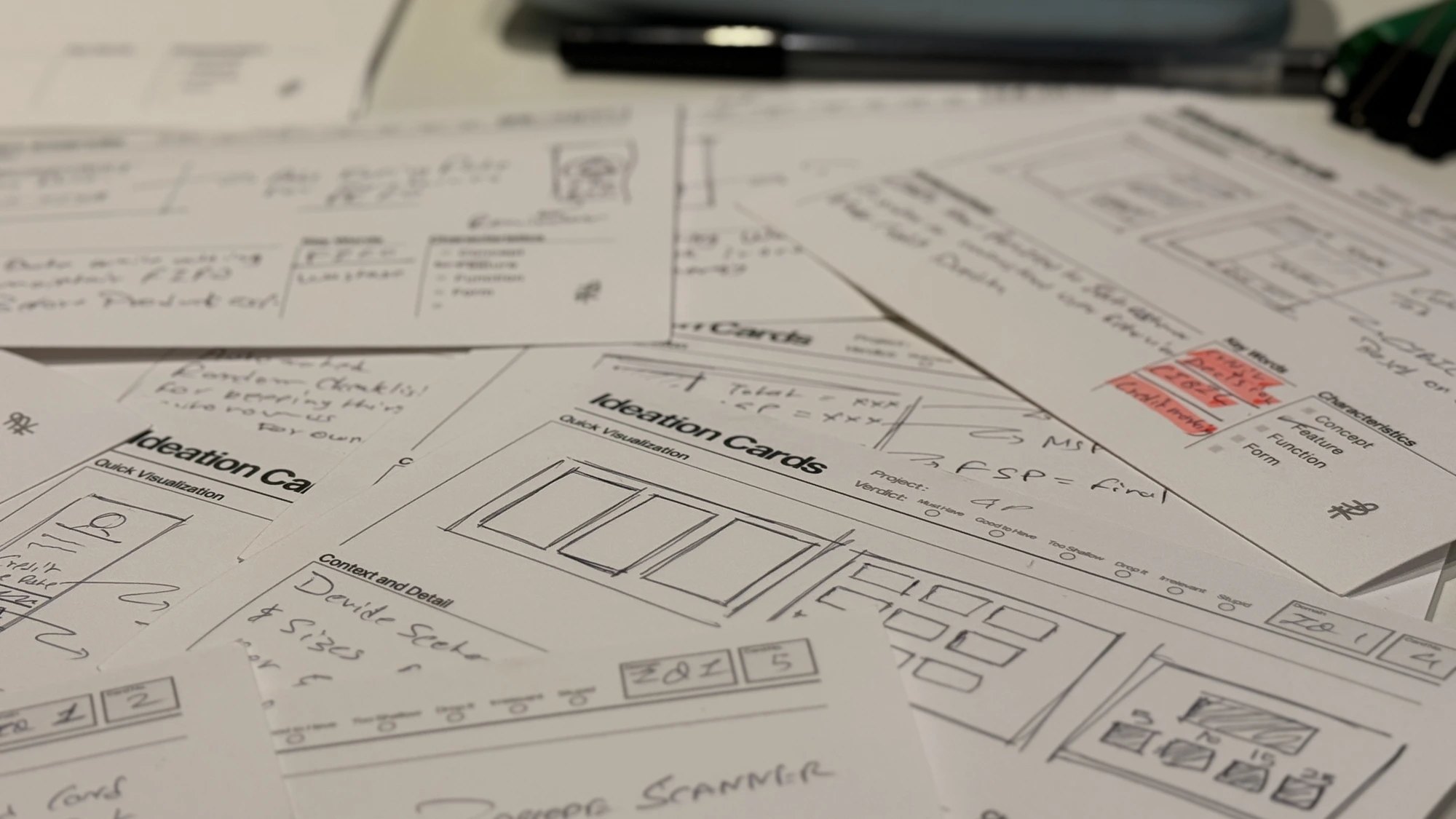
Ideation cards on the studio table.
Where insights begin turning into concepts — quick visualization, context, verdict
01
No unified operational system — only mental integration
Selling, stock, credit and purchasing all exist, but do not connect. The owner acts as the integrator of the entire business, in real time.
02
Cognitive load replaces system design
Memory and coordination are handled mentally — limiting consistency, scalability and transferability.
03
Data is generated continuously but never captured structurally
Every transaction creates signals. The absence of effortless capture keeps decisions instinct-driven.
04
Distributed execution with centralised control creates bottlenecks
Work is shared across people, but authority stays with the owner — slowing decisions and making the system fragile to scale.
05
Speed and control cannot coexist in the current system
To keep speed, structure is avoided; to gain control, operations slow down. A constant trade-off with no resolution.
Which leads to
Two design challenges. One system.
Design Challenge · Product Centric
Design a centralised operating product — the core console for structuring and recording daily business transactions with their origin, purpose and context, without interrupting the natural speed and flow of the shop. A catalyst for structured working, able to support plug-in modular micro-services.
Design Challenge · Service Centric
Design a plug-and-use modular micro-services ecosystem that extends the central system — using structured business data to deliver capabilities across market intelligence, finance, operations and growth. Starting essential, compounding over time, keeping the business lean and adaptable.
Next Chapter
Random AI music — not the best, but keeps you going